Saturday, February 19, 2011

A Lot of Light At Hand

When I commute to work, I take a lot of back roads and the occasional footpath since the bike routes here are either non-existent or a lethal joke in many cases. Additionally, living on the eastern edge of the time zone means the sun sets "early" (and rises early too), meaning that I'm often cycling in the dark. This is different than my usual wandering around in a fog, because good lights help.

After an old 4-C cell Cateye light I'd used for a decade finally broke, I put a Cateye HL-EL530 headlight on my bike in addition to the 15+ year old EL-500. I was not impressed with the new unit, and the old one, though utterly reliable as a backup and for short range lighting was limping along on a K-2 halogen bulb.

Although the 530 was fairly bright, it uses a magnetic switch inside the case coupled with a vibration-prone magnet on the external switch to turn it on and off. It was very easy to accidentally turn the unit on and run the batteries down. So much so that I eventually put a piece of duct tape on the switch to prevent the problem. In addition, the "Flex Tite" mounting system, though clever, was the removable version of a big zip tie -- a screw driven plastic strap and was sort of rickety (though if you had a non-round section to attach it to, I can see how it would be nice). Quite a step down from the sturdy clamp mounts found on most bikes. To cap it off, the mounting rails that the light head slides into were fiddly -- on more than one occasion the 530 light head would simply bounce off into the street after not latching correctly. The light only suffered scratches, but that's really annoying.

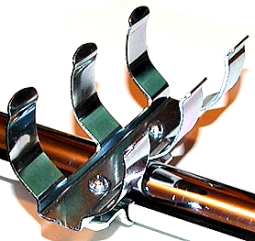
The solution was to stop whining and do something better. I cribbed a design from the "Flashlight" section of the exhaustingly complete (though not recently updated) bicyclelighting.com. The author, Steven M. Scharf, makes the good point that handheld lights are available with scads more power at a fraction of the cost of dedicated bike headlights. What is needed is a sturdy holder for them (not like the wimpy stamped metal ones from years ago, though, astonishingly, those are still being made).

The result was fairly close to Scharf's original design, though with a couple of changes. I could not find the rail mounts that he mentioned, and found that Bike Nashbar has a clamp mount handlebar bottle bracket (NA-HBCC) that works splendidly and has a bar of sturdy plastic to help the mounting assembly. These could be used to mount nearly anything on your bars -- GPS', lights, cameras, whirlygigs, foghorns, pets, children, tollway passes etc. etc.

The only other part you need is a strip of aluminum stock (in this case 3/4" x 1/8" works perfectly), the Lite Clamps from Nite Ize (or something similar -- these are sturdy) and some screws to hold it all together. I went for some M5 x 0.8 stainless cap screws, washers and stop nuts (the kind with the little nylon insert in them that keeps them from working loose). Scharf also used heat shrink tubing to protect the handlbar finish, whereas I just put a turn of PVC tape on the bar.

The light is a "Task Force" 3-Watt, 2-C flashlight from Lowes (FT-NS-2C-3W). These are shipped with the monster CREE 150 lumen emitter and are literally dangerously bright. Don't look into the beam at close range! Also check that they're *NOT* the substantially dimmer Luxeon version sold under the same part number. The correct one will have labeling tagged with things like "60 times brighter" and will not have any mention of the Luxeon trade name.

After the first test run, I remembered the other annoying thing that bike light manufacturers were doing; substituting raw power for engineering. If you look at the headlight on a car, scooter (or one of the older filament bulb bike lights), they have carefully designed optics, creating a broad path of light in an optimal pattern for driving. The new LED versions simply put out tons of light in a spot pattern and depend on the "spillage" to handle peripheral areas, which works very badly. The reality is that you're working with a narrow spot or elliptical path of light, usually at a distance, and there's always a problem with seeing bumps and ruts that are close. You need distance vision and the path leading up to your front tire, which is why my old EL-500 soldiers on year after year; it makes a great close-range light. When I was in grad school and this was all I was using, I'd move the beam up when going faster to see farther ahead. Also a good light for changing tires, finding keys, reading comic books under the covers etc. But again, it was at the limit of what I could get from it using a simple filament bulb.

So, the next stop is to herk up the old EL-500 - an easy task with a nifty -- if pricey -- retrofit 1W LED bulb from Nite Ize (LBR-07-PR1W). It's a drop-in proposition, since there's an internal voltage regulator. So, shelling out a few bucks ($15, actually) and thirty seconds work brought the old favorite into the twenty-first century. In fact, if you root around a bit, you can find these emitters for ~$10, which is cheaper than replacing the light. Be aware that Nite Ize has a lower power retrofit that looks the same and costs less - probably not good for this kind of application.

If you were doing this from scratch, it would be cheaper and simpler to find a LED lamp that has a broad short-range beam pattern.

How did it work? HOLY CRAP IS THIS BRIGHT!!!!. The combination is easily as good as a small motorcycle light and maybe then some. I had to carefully aim the flashlight to not blind someone, and the retrofitted EL-500 works wonderfully to fill in the near stuff (and in fact is bright enough to use by itself a lot of the time). I'm not going to post dorky patterns of pools of light like some of the light geeks do, but take my word for it.

The small light can be turned on easily with my thumb and the big one can be too though it's a stretch. The only improvement might be a loop of safety line around the flashlight to keep it seated in case of a really severe bump, but it's shown no signs of coming adrift.


Total cost? About $60 for the whole thing.

  • Task Force 3W Headlamp: $25 (Lowes, on sale)
  • Clamp: $8 (Bike Nashbar)
  • Clips for light: $7 (Nite Ize)
  • 1W Retrofit emitter for EL-500: $15 (can be gotten more cheaply online)
  • Nuts, bolts, tape, bandaids: ~$4
UPDATE:
  • Adding an "O" ring to the groove machined in the end of the body of the Task Force light helps it seat in the clamps without trying to slide. There are other grooves that might be used this way to help the clips, but this was all I needed.
  • I've added a velcro strap to hold the whole thing in, but so far it's not really been necessary.

Monday, July 20, 2009

Stuff I Don't Leave The Beaten Path Without (2).

A Pentax W- series waterproof point-and-shoot camera. Mine is a W-10 that's about three years old and goes everywhere with me. I take many of the photographs for this page with it, and have sold as many shots from it as from my pet Nikon SLR. The latest iteration is the W-60, with the W-80 just introduced.

Battery life is very good - roughly a week's messing around without too many flash shots, and the thing is *durable*! I've taken this sailing in salt water, crewing on race boats, sticking it out into the slipstream at altitude and on all kinds of hikes and adventures and it refuses to malfunction or die. For whitewater rafting I just tuck it on a lanyard down the front of my vest. Mine has a few scratches and dings on it but those are badges of honor. It will shoot video underwater (to about 10 feet / 3 meters) and closeups very well, and its small size guarantees it goes along with me everywhere, which means that I get to blackmail everybody who went skinnydipping.

Its only annoying features are that the battery is perfectly rectangular, which means you can put it in upside down (contacts facing inward, but on the wrong side) and the camera won't work. Marking the battery slot and the camera solves that one. The focusing system makes a lot of gear noise during video shots that the microphone picks up, but this seems universal in point-and-shoots.

Also, in *this* model (W-10), the video comes out in Quicktime (.mov) format and has to be converted for windows work. Newer models output video in .avi formats, with the most recent being 720p HD which looks pretty good given the lens size etc.

Pentax has produced this series for some time, and their habit of regularly superseding models with increases in functionality at each generation works to your advantage. For example, when the W-20 series was being superseded by the W-30, I found a backup W-10 on closeout for $100 on Ebay, new in the box. Problem is, I don't use it -- the original refuses to die!

So, if you're willing to have 10 Mp* and not the latest 12 Mp* (just think of the poor guy who had to count all those) with all the most recent iteration's bells and whistles you can have a very good camera at a very good price. This guarantees that not only are your adventures saved for posterity, but you can tell "No shit, there I was..." stories with accompanying pictures or HD video.

Of course, if you're making it all up, you'd better get busy with Photoshop.

(UPDATE: Fortuitously, the New York Times has a review of watertight point-and-shoot cameras.

http://www.nytimes.com/2009/07/23/technology/personaltech/23basics.html

Make your own choice, but having a small, sturdy, waterproof camera along is a joy ).


* Unless you like to clog up your memory cards and computer with huge photo files (and/or are doing it for money) setting the file size choice to 2 - 6 Mp suffices for nearly everything.

Trangia Mini -- $ 1 Modification For Use With Snow Peak And Other Ultralight Cookware


I love the Trangia burners -- they're incredibly sturdy, run hot and will store excess fuel in the stove by simply putting the lid on. I purchased a Trangia Mini cookset some years ago at an REI sale ($12, I think) and it does a great job. Came with a little pot, lid/frypan, a windscreen and a pot lifter (that all work better than you'd think).

I've tinkered with beer can stoves and other cult favorites, but after bandaging my fingers and putting the squished wreckage aside, I keep coming back to my quiet favorite.


Ultralight (usually titanium) cups and tiny pot-sets are great too -- weigh almost nothing and do just fine for small amounts of whatever it is you're heating up. Unfortunately, many of the ultralight cooksets such as those offered by Snow Peak and others are sized to *juuuuust* fit a standard pressurized gas fuel canister.


Also unfortunately, the windscreen on the Trangia Mini cook kit has a diameter that is slightly larger than this, and using a mug or mini-cookset that is sized for a gas canister will guarantee that the windscreen can't keep it above the flame -- it just drops down inside the windscreen and puts the burner out (or something even more entertaining). The obvious solution is to bend the tips of the windscreen slightly inward , but when you do that, the tips no longer engage an embossed ring in the bottom of the Trangia pot, allowing it to sit askew or to slide off.


A better solution is to get four #8 x 1/2" aluminum sheet metal screws [or their approximate metric equivalent]. Any good hardware store should have some specialty trays for these (I think they're used in screen and door repair) at about a quarter apiece. No bonus points for looting the neighbor's screen door.

Drill a 3/32 pilot hole about 3/8" below the top of each windscreen tip and put the screws through the holes, point facing inward.


So you wind up with four aluminum screws facing inward as supports for slightly undersized cookware. You can sand or file the tips off to reduce snagging as you handle the burner (use a fine wood rasp rather than a metal file as aluminum will clog the teeth of the latter).

A couple of things here:

  • The 3/32" pilot hole is slightly undersized for the application. This is intentional to get the aluminum of both the screw and the windscreen to deform and abrade at the expense of having to work a little harder to get them in. You can see how it's actually pushed the windscreen's metal out a bit. This provides a good tight fit, and with some luck as the aluminum oxidizes slightly that will fuse everything together very tightly.

  • This uses aluminum screws instead of, say, stainless steel. I'm not a total gram weenie, but the screws are lighter. More importantly they're the same material (if not exactly the same alloy) as the windscreen, so there's very little likelihood of electrolytic ("bimetallic") corrosion from fuel vapor, salt water, spilled beef bourguignon, and the like. Also, the metals will expand at about the same rate, so thermal cycling won't make them come loose. Yes, I overthink things, but it works and this is playing with fire (fun!!) after all.
Results:

This way, both the original pot and any small cups or pots are supported. This is the bottom of a Snow Peak 600 mug. The Snow Peak Mini -Solo set fits similarly.


And the original pot support ring still engages. Woot!

Why bother?

If you already carry a cup that can be used for heating, as many people do, you now have a small pot, small frying pan and ability to heat things in the cup all in one at no significant additional weight. Not bad for a buck.


Thursday, July 16, 2009

Stuff I Don't Leave The Beaten Path Without (1).

A Garmin Foretrex 101. Simple, inexpensive (less than $100 online) and will-get-you-home. I splurged for the bike clip and use it as a bike odometer when in civilization. I've carried it all over the world and geotagged all sorts of places in typical geeky fashion, but on and on it goes. Unfortunately it has a serial interface and what computer has a serial port these days (yes, you can get interface adapters).

The 201 is rechargable, but I'd rather carry extra batteries than spend my time trying to find a wall socket. My experience with lithium batteries in these is that they work in the coldest of weather, but the battery indicator doesn't work all that well with them and the cell life seems about the same. Lithium disposables have a weird, flat voltage curve, so if the battery indicator says anything but "full", get ready to change them.

My first good portable GPS, a Garmin GPS III+ (which I still have) has saved my dyslexic bacon from time to time, but was a big lump to carry. I can navigate boats and my feet with this little thing. It's not convenient in driving airplanes, but it does work. No frills -- it won't replace your IClone 9000 GonzoMatic Satellite-Uplink touch screen, but I haven't broken it yet and it goes and goes on a single set of batteries. It also comes with a strap extender so you can wear it outside a jacket (or even thick foulies as I found out boat racing with it). Very waterproof -- never gone diving with it but dousing with rain and saltwater hasn't killed it (yet).

The very-similar 301, which has just been released claims a higher sensitivity reciever, slightly better battery life (18 vs. 15 hours per set of AAA batteries) and a USB interface, all good things, plus a slightly smaller box for the same screen. It's not clear if the timers available in the 101 version (sailing countdown timers etc.) are in the 301's software.

If someone wants to donate one, I'd be happy to look.

Tuesday, December 9, 2008

Signs of Cabin Fever

.

Okay, I've been cooped up in the sleet and ice for entirely too long grading end-of-semester exams and term projects. The only way I can get through this mind-numbing exercise is to turn the television on, which is something I seldom do otherwise except when parked on various exercise gizmos.

The point of this is in order that, between trying to decipher for the thousandth time yet another student's handwriting (and determine that, yes, they have indeed written the answer they should have, more or less), and the gabbling yawp of the television, my brain doesn't turn to lime JellO. With bits of fruit cocktail.

If you do this long enough you begin to wonder about a few things on television:

The Rambo Non-Conservancy Principle:

Why does Rambo get some kind of minor injury in every scene in the movies, yet they never accumulate, even to the extent of cuts no longer bleeding extensively in the next scene? Most people would be well-pulped after twenty minutes or so.

The Bond Conundrum:

Why does James Bond only stuff a very few gadgets in his pocket when he sets out to pillage and seduce, yet these are *exactly* the items that he will need, even to the extent of having none left over that he never used? I've got enough widgetry in the garage to build an F-16 (and probably the aircraft carrier to go underneath it) and it seems that I'm always missing something while not using most of what's there.

The House Credibility Blur:

How are the doctors on "House" able to give a different definitive diagnosis and changed course of treatment every five minutes to the same patient without a problem? I think they have confused "Differential Diagnosis" with "Different Diagnoses". If I brought someone into the hospital and a flotilla of physicians changed their minds (and operated or medicated with experimental goo every time they did so) with that frequency, we'd certainly be out of there and on the way to the lawyer's in nothing flat.

The CSI Green-Tinged Up-Set:

I've been in laboratories literally all my life and I've never seen one so poorly lit and overdecorated as to be too chi-chi for most martini lounges, yet this is how all of the big science on the CSI set gets done. If you dropped a pencil in that environment you'd never see it again until the building was demolished, much less trying to resolve any kind of detail in physical samples.

As an extension of this architectural suspension-of-disbelief, there are a lot of scenes set in older turn-of-the century building supposedly in Las Vegas. Las Vegas wasn't in Las Vegas at the turn of the (last) century, much less with green lawns. And speaking of green, how is it that they've decided to permanently turn off the white balance in their cameras so that half the scenes look like out-takes from "Seven"?

The West Wing Economic Deflation:

The West Wing, which one could classify at this point as being the fiddle that was played in reruns while Bush allowed his idiots to burn our economy and foreign policy to smoldering waste, is a great feel-good show about how tough it is to make world-scale decisions about actors in a mockup of the White House. Oh, wait, that's supposed to be the president and his related minions except he's principled and literate.

What isn't shown at any time is fund raising that is constantly done in the real world of politics. With congressional campaigns running into the tens of millions of dollars (and a lot of those contributions being converted into private capital unless they have to be spent on something pesky like campaign expenses), it's a nonstop feeding frenzy most of the time. I believe the minimum is something like $10,000 per day in order to run a congressional reelection campaign every four years. Never mind the presidency. In the few episodes I've watched, I have yet to see a check change hands in a cloakroom anywhere.

.

Monday, December 1, 2008

Correlation and Causation Explained

One of the most common human error is to confuse a causal effect with a correlation.

A causal effect, as the name implies, means that one of the items being considered has a mechanism for producing some kind of change or action in the other. Thus, if you have rhinovirus organisms present around you, you're very likely to catch cold because one will cause the other.

A correlation is where items are simply statistically linked. There may be an underlying causal mechanism -- this is usually where they're first considered and may eventually be discovered, but there's no proof that one actually causes the other. There is simply a close association. An example of *this* might be being cold and wet and then catching cold. It's often correlated, but simply being cold and wet won't make you sick in any direct fashion.

There are a lot of examples of this (correlation of the stock market with skirt lengths or sidewalk temperatures, for instance). Most of these are pretty silly, but using this natural tendency to link two closely associated things as one causing the other is the basis of many human undertakings from superstitions to nutrition and advertising.

Where is all this going?

Right here: http://statestats.appspot.com/

You can look at the correlation between search terms on Google, and the statistics about people the states that are doing these searches. Thus, if you search for "cats", you'll find that there's 100% correlation with people from New Hampshire, and there will be a column of related statistics having to do with people from those states (obesity, education, same-sex marriage etc.) that is hilarious. You'll find yourself jumping to conclusions right away.

You can go wild with this - it doesn't flinch from nasty search terms so you can see where the pervs live (or at least correlate well). Also, you can link search terms with a "+" sign. Try "mittens+sex" -- Texas and Kansas are the winners there.

It makes one wonder.

Do read the "Be careful drawing conclusions from this data" disclaimer.

Tuesday, October 14, 2008

Wednesday, October 1, 2008

...Lunch!


The Morris Culinary Ostentation Index
:

  • Restaurants will charge about 30% more for food if it's festooned with squiggly sauces of some sort (presumably they've found a use for the surplus catsup bottles in the back).
  • If the squiggles run in two directions, then the surcharge is about 43%.
  • Food that's artificially constructed into a higher fractal order (that is, sculpted into tree-like thingies that stick up off the plate) add about another 73.5% on top of the first two.
  • Finally, if there's gold leaf on any of it you'd better have American Express because the Visa's going to melt into slag.
  • More than one adjective per menu item and the price rises commensurate with the ostentation as well.

So -- Hypothesize a basic cheeseburger and fries: $7.50

Squiggly Sauce -- 1 direction: $9.75

Squiggly Sauce -- 2 directions: $10.75

Three dimensional sculpted version: $18.60

"Boeuf carbonée avec moutarde et tomato-vinaigrette sauce sur le pain, pommes frites et un petit gherkin" : $48.75

~~~~~~~~~~~~~~~~~~~~~~~~~~~~~~~~

Today's Example:


"Instead of the classic French ham and cheese sandwich, Hatfield's crafts its "croque-madame" ($18) out of cool slices of hamachi layered with salty prosciutto and buttery toasted brioche. The final topping is a quail egg fried sunny-side up. "

From the New York Times travel section -- "Los Angeles's Revived Culinary Scene" (10/1/08)


Yes, that's a ham sandwich the size of a quarter, with a marble-sized egg on top... for $18.